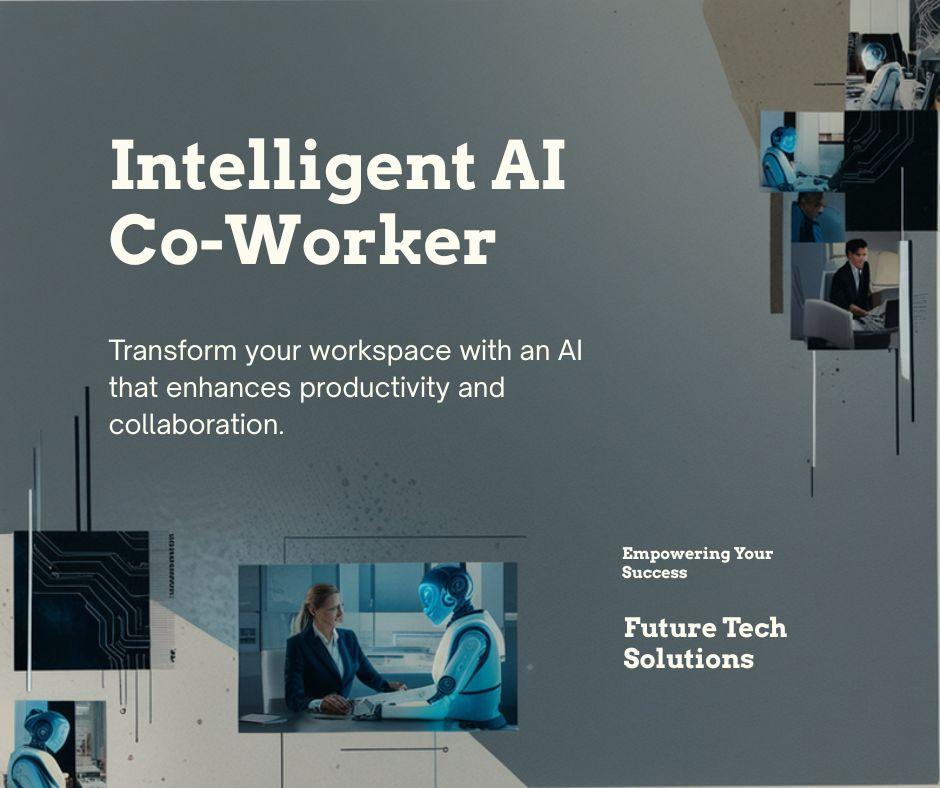
The Hidden Cost of Manual Workflows: Why Your Team Needs an Intelligent AI Co-Worker
The Hidden Cost of Manual Workflows: Why Your Team Needs an Intelligent AI Co-Worker
Manual, repetitive tasks drain employee morale, stifle innovation, and incur massive hidden costs. Implementing intelligent, autonomous AI co-workers automates these mundane workflows—from invoice processing to data extraction—allowing your team to focus exclusively on high-value, strategic initiatives that actually drive revenue.
In our consulting experience at Microquants, we frequently audit the internal operations of mid-sized German enterprises. Almost universally, we uncover a shocking reality: highly educated, exceptionally well-paid professionals are spending up to 40% of their workweek acting as human glue between disconnected software systems. They are copy-pasting data from PDFs into CRMs, manually summarizing lengthy legal documents, and managing clunky, error-prone spreadsheets.
This isn't just a minor operational inefficiency; it's a massive, silent drain on your company's most valuable and expensive resource: human ingenuity. Today, the technology exists to completely eliminate this busywork. In this article, we will expose the true cost of manual workflows, explain the difference between traditional automation and modern "AI Co-Workers," and provide a roadmap for deploying autonomous agents in your enterprise.
The Silent Profit Killer: The True Cost of Manual Tasks
When executives calculate the cost of a manual workflow, they usually just multiply an employee's hourly rate by the time spent on the task. This rudimentary math vastly underestimates the true damage. Manual workflows introduce systemic risks that scale non-linearly as your company grows.
High Error Rates and Compliance Risks
Humans are not designed for endless repetition. Fatigue inevitably sets in, leading to data entry errors, missed emails, and overlooked discrepancies. In fields like finance, healthcare, or logistics, a single transposed digit in a spreadsheet can result in catastrophic compliance violations, lost shipments, or massive financial penalties. Human error is an unavoidable feature of manual processes, and quality assurance requires hiring more humans to check the work of the first group, compounding the inefficiency.
Employee Burnout and Churn
Forcing talented individuals to act like unthinking robots leads directly to low job satisfaction. When you hire an ambitious supply chain manager, they want to optimize global routing strategies, not spend three hours every morning manually typing tracking numbers from emails into a database. Boring, repetitive work is one of the primary drivers of employee burnout and churn. The hidden cost of replacing, onboarding, and training a frustrated employee far exceeds the cost of automating the task they hated doing.
The Scaling Bottleneck
Perhaps the most critical issue is that manual workflows scale linearly with headcount. If it takes one employee to process 100 invoices a day, processing 1,000 invoices requires hiring nine more people. This prevents hyper-growth. Rapidly scaling a company is physically impossible if your core operational processes rely on manual human hand-offs. You become trapped by your own operational bloat.
Moving Beyond RPA: The Rise of the Intelligent AI Co-Worker
For years, companies have tried to solve this with Robotic Process Automation (RPA)—essentially "screen-scraping" bots that click buttons and copy text based on rigid rules. The problem with RPA is that it breaks the second anything changes. If an invoice format changes slightly, or a website moves a button five pixels to the left, the RPA bot crashes, and an engineer has to spend hours fixing the script.
What Makes an AI Agent "Intelligent"?
Modern AI Co-Workers (or Autonomous Agents) represent a quantum leap beyond RPA. They are powered by Large Language Models (LLMs) equipped with tool-use capabilities. Unlike a rigid script, an AI agent understands intent and context.
If you ask an AI agent to "Extract the total amount due from this invoice and enter it into Salesforce," the agent uses its semantic understanding to find the total amount—whether it's labeled "Total," "Amount Due," or hidden at the bottom of a completely new PDF layout. It doesn't rely on rigid coordinates; it reads the document much like a human would. Furthermore, it can independently navigate software APIs to execute actions, pulling data from an email, transforming it, and pushing it to a database autonomously.
Human-in-the-Loop: Augmentation, Not Replacement
It is crucial to understand that AI Co-Workers are designed to augment your staff, not replace them. We strongly advocate for "Human-in-the-Loop" architectures. The AI handles the 90% of routine, boring tasks effortlessly. However, when the AI encounters a severe anomaly—a highly unusual contract clause or a mathematically impossible invoice—it pauses the workflow and routes the specific issue to a human expert for review. This ensures complete accuracy while maximizing speed, allowing your human staff to act as strategic overseers rather than data entry clerks.
Top Use Cases for AI Agents in German Enterprises
The applicability of AI Co-Workers is vast, but we see the most immediate ROI in processes that are data-heavy, repetitive, and currently rely on manual text interpretation.
Automated Customer Support Triage
Customer support teams are often overwhelmed by repetitive inquiries ("Where is my order?", "How do I reset my password?"). An AI Co-Worker can integrate directly with your inbox or ticketing system. It reads the incoming email, queries your internal databases to find the tracking information or account status, and either drafts a highly personalized response for a human agent to approve, or, for simple queries, resolves the ticket autonomously. This slashes response times from hours to seconds.
Invoice Processing and Financial Reconciliation
Accounting departments drown in unstructured data. Suppliers send invoices in hundreds of different PDF formats, Word documents, and physical scans. An AI agent can monitor an accounts payable inbox, intelligently extract line items, tax IDs, and totals from any format, cross-reference them against purchase orders in your ERP system, and flag discrepancies for human review.
Semantic Document Search and Data Extraction
Legal, HR, and compliance teams spend countless hours hunting for specific clauses in massive document repositories. An AI Co-Worker hooked into a secure Retrieval-Augmented Generation (RAG) pipeline allows employees to simply ask, "Which of our vendor contracts contain a liability clause exceeding 1 million Euros?" The agent instantly scans thousands of documents and returns a compiled list with direct citations, turning a three-week research project into a three-minute query.
Case Study: Reclaiming 30% of a Legal Team's Time with a Custom AI Co-Worker
We recently partnered with a mid-sized corporate law firm in Frankfurt. Their paralegals were spending nearly 30% of their billable hours manually reviewing massive Non-Disclosure Agreements (NDAs) sent by clients, checking them against the firm's standard acceptable terms. It was soul-crushing work.
We built a custom AI Co-Worker using an open-weights LLM deployed on their secure, local servers to guarantee absolute client confidentiality. We trained the agent on the firm's playbook of acceptable and unacceptable clauses.
Now, when a new NDA arrives, the AI Co-Worker automatically reads it, highlights every clause that deviates from the firm's standard, explains exactly why it deviates, and drafts suggested redline revisions. The human lawyer simply reviews the AI's summary and approves the changes. We measured a 75% reduction in the time required to process a standard NDA, massively increasing the firm's overall capacity and eliminating paralegal burnout.
How to Implement Your First AI Co-Worker in 30 Days
Deploying your first AI Co-Worker doesn't require a massive digital transformation budget. It requires a targeted, surgical approach.
- Audit for Pain Points: Ask your team: "What is the most repetitive, annoying task you do every week that requires reading or writing text?"
- Define the Boundaries: Select a single, well-defined workflow. Do not attempt to automate the entire department. Focus on a high-volume, low-complexity task to serve as a Proof-of-Concept.
- Build the Integration Layer: The magic of an AI agent is its ability to interact with your tools. You need software engineers to securely connect the LLM to your existing APIs (your CRM, email server, or Slack).
- Implement Human-in-the-Loop: Build a simple dashboard where the AI agent queues its work for human approval until you fully trust its accuracy.
Conclusion
The era of paying smart humans to do robotic work is over. The hidden costs—in errors, burnout, and stagnant growth—are simply too high to ignore. Intelligent AI Co-Workers offer a practical, immediate solution to supercharge your team's productivity. By automating the mundane, you free your employees to do what humans do best: build relationships, solve complex strategic problems, and drive your business forward.
Stop wasting your team's potential on repetitive, robotic tasks. Let's explore how custom, secure AI agents can automate your most painful workflows and reclaim thousands of hours for your enterprise.
Sources
- McKinsey & Company on Generative AI and Automation – Research on the massive productivity gains achievable through AI.
- Harvard Business Review: The AI-Powered Organization – Insights on restructuring teams around intelligent automation.
Author: Microquants Software Solutions
Bio: We are a Frankfurt-based technical consultancy specializing in AI Proof-of-Concepts (PoCs), custom AI agent development, and high-end software engineering for European SMEs and mid-sized companies. We build the intelligent systems that power modern enterprises.